
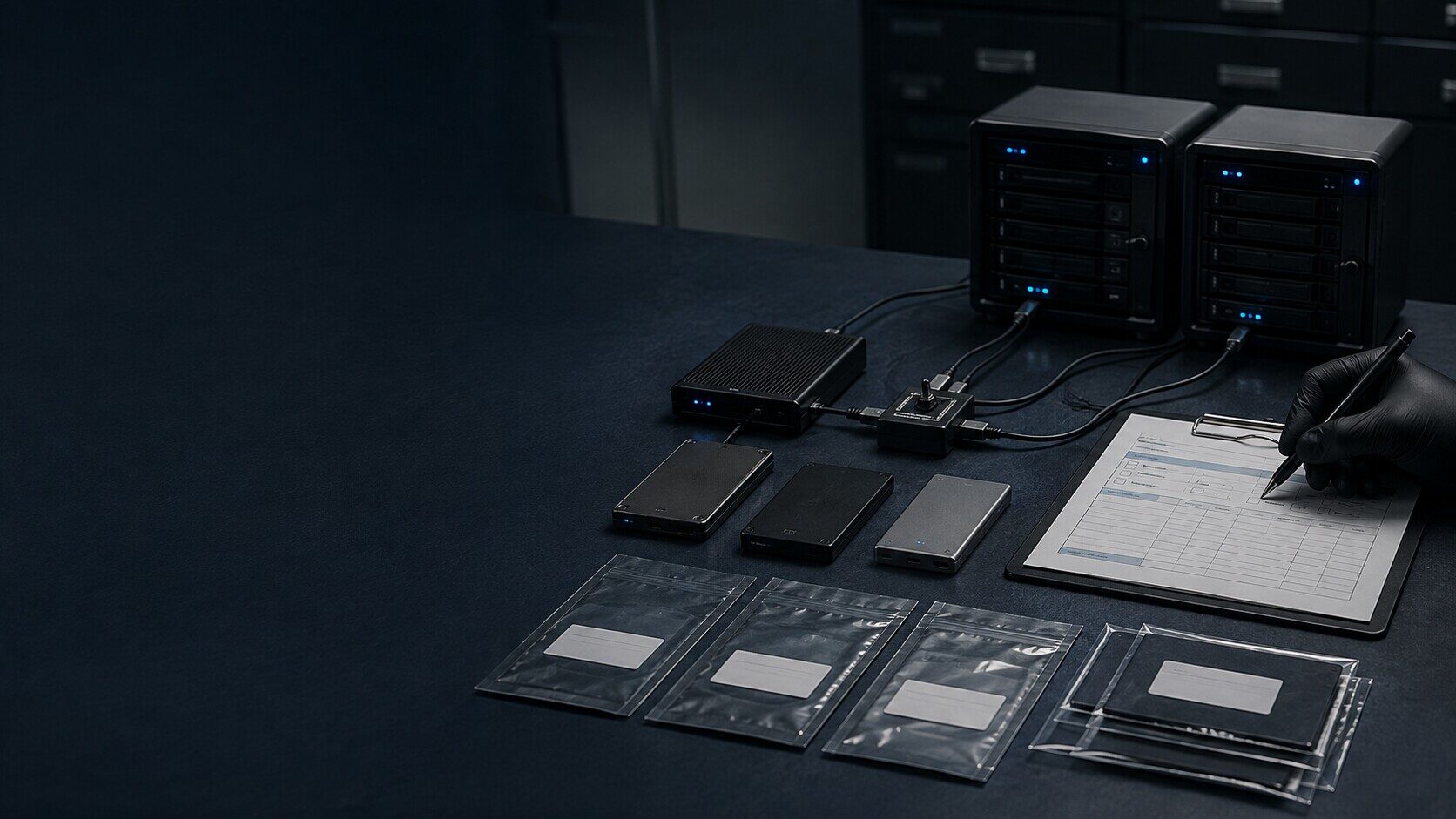
Documented process and stated limits
Quality Standards, Evidence Handling and Data Security
A clear account of how digital evidence is scoped, acquired, verified, protected, examined, reviewed, transferred, retained, returned or deleted. The exact controls and any service-specific status are confirmed in the written scope for each instruction.
Authority and scope recorded · Source and working copy distinguished · Exceptions and limitations stated
Service-specific assurance
The written scope states what applies
Accreditation, regulatory status, validation and review arrangements can differ by activity, jurisdiction and method. The written scope identifies what applies to the instruction; no process can guarantee admissibility or a particular evidential result.
Evidence lifecycle
A documented path from authority to disposition
- Scope. Record authority, conflicts, questions, sources, source state, exclusions and required output.
- Acquire. Select an on-site, remote, full or targeted method that is proportionate to the source and assurance required.
- Verify and protect. Record manifests, hashes where applicable, errors, encryption and transfer details.
- Examine and review. Preserve working notes, distinguish tool output from interpretation and apply checks appropriate to the question.
- Deliver and close. Provide the agreed output, record hand-off and follow the case-specific retention, return or deletion arrangement.
Authority, scope and continuity
- Identify the instructing authority, relevant parties and permitted source access.
- Record source description and state, custodian information and any existing exhibit or case reference.
- Define what is included, excluded or technically unavailable.
- Use a manifest and verification values where they are appropriate to the method.
- Record transfers, material exceptions and the relationship between source and working copy.
Remote collection controls
Where suitable, a live system may be collected through an encrypted collection agent. A switched-off system may be started from a controlled bootable USB or CD. The written method identifies who performs each step, how authority and source state are confirmed, what is collected, how the result is encrypted and verified, and how it is handed back.
Remote collection is not assumed to suit every source. Encryption, connectivity, device condition, access, data volume or assurance requirements may require attendance or another method.
Protection without publishing a security blueprint
Access, storage and transfer
- Use the public website only for conflict and scope information, never for evidential files or credentials.
- Agree a case reference and transfer route after suitability and scope checks.
- Limit access to the people and suppliers required for the agreed role.
- Apply encryption and access controls appropriate to the material, method and transfer.
- Record case-specific retention, return and deletion instructions, including any legal hold exception.
Method discipline
Validation, interpretation and review
- Choose methods and tools for the source and question rather than relying on one default output.
- Record relevant versions, settings, errors, warnings and incomplete results.
- Cross-check significant findings against source artefacts or another suitable method where proportionate.
- Separate observation, inference and opinion in notes and reports.
- Describe the actual technical review arrangement without implying an undisclosed team.
Service-specific status
Ask what applies to this activity and jurisdiction
Acquisition and collection
The scope should state the source, method, operator, verification, exceptions and hand-off required for the chosen collection.
Examination and reporting
The report should identify material relied on, method, significant findings, assumptions, limitations and the author responsible for any opinion.
Complementary disciplines
Another specialist’s identity, instruction, fee, report and responsibility for their own opinion are agreed separately.
Regulatory and procedural wording
Any applicable duty, code, declaration or status is checked for the service and jurisdiction at the time of instruction rather than presented as a universal badge.
Official regulatory source
Forensic Science Regulator Code of Practice
The current statutory source should be checked for the activity and jurisdiction concerned. See the government publication of the Forensic Science Regulator Code of Practice, version 2. Linking to the Code does not imply that every service has the same regulatory or accreditation status.
International attendance and data movement
Alistair is UK based and available for worldwide travel, including across EMEA, by agreement. Willingness to travel does not itself authorise devices or data to cross a border. The instruction must address legal authority, data-transfer restrictions, equipment movement, security, safety, timetable and cost.
What quality controls cannot promise
- No process guarantees recovery, completeness, attribution, admissibility or a particular outcome.
- A matching hash confirms matching data streams, not the source’s earlier history or human actor.
- Expired, overwritten, inaccessible or uncollected records can leave unresolved gaps.
- Proportionate scope is assessed against the instructed questions, not every record that may ever have existed.
Practical questions
Can evidence be sent with the first enquiry?
No. Send only party names, the question, broad source types and deadline. A suitable transfer or collection route is agreed after conflict, authority and scope checks.
Does hashing prove the evidence is authentic?
A matching hash can show that two acquired data streams match. It does not by itself establish who created the source, whether earlier changes occurred or what a record means.
Is every service accredited or regulated in the same way?
No blanket status is claimed. Applicable standards, declarations, validation and review arrangements depend on the activity, jurisdiction and instruction and should be stated precisely.
Requirements differ by instruction
Discuss evidence-handling and assurance needs
Describe the proposed sources, location, method, hand-off and required output without sending evidence. The written scope can then record the controls and limitations that apply.